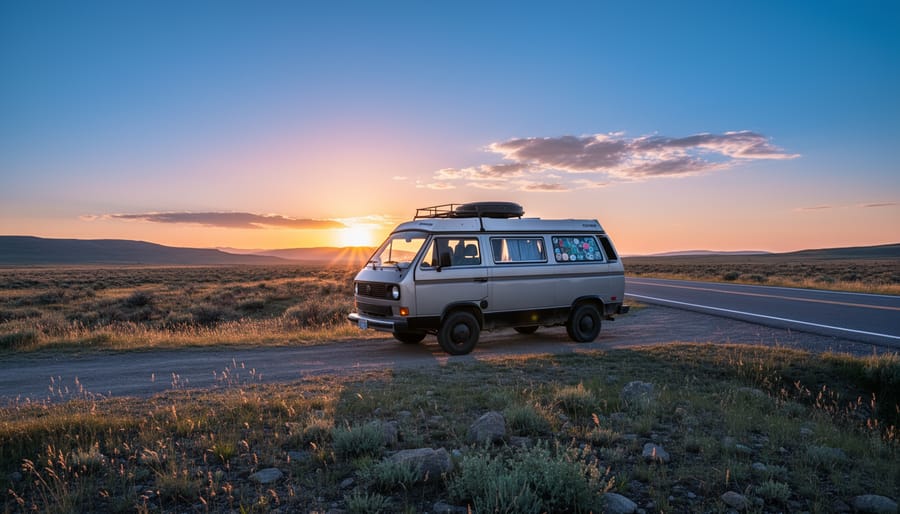
Nomadic travel means living without a fixed home base, moving from place to place while working, exploring, and building a life on the road. It’s not a permanent vacation. It’s a deliberate lifestyle shift that replaces traditional housing with mobility, whether you’re in a van, RV, or bouncing between short-term rentals across countries. For most people starting out in 2026, this begins with remote work or location-independent income, a willingness to downsize possessions dramatically, and the systems to handle logistics like mail forwarding, healthcare, and connectivity from anywhere.
The appeal is obvious: freedom to wake up in new landscapes, escape high rent, and design your days around what matters to you instead of a zip code. But here’s what nobody mentions in those sunset Instagram posts. Nomadic travel demands more planning than stationary life, not less. You’re constantly solving problems: where to sleep legally, how to stay connected for work calls, what to do when your transmission fails in rural Montana, and how to maintain relationships when you’re never in one place long.
This isn’t about running away. The people thriving on the road treat it like any other life structure, just portable. They build routines, create income stability, and know when to slow down instead of burning out by moving every three days. If you’re weighing whether nomadic travel fits your life or wondering how to actually make it work past the honeymoon phase, you need both the inspiration and the honest operational details. That’s exactly what we’re covering here.
What Nomadic Travel Really Means (And What It Doesn’t)
Nomadic travel isn’t a single lifestyle, it’s a spectrum. At one end, you have weekend warriors who pack up their Subaru every Friday and sleep at a different trailhead. In the middle, you’ll find seasonal nomads who spend summers exploring and winters in one spot, plus remote workers who split time between home bases and extended road trips. At the far end are full-timers who’ve sold everything and haven’t paid rent in years. Van life, RV travel, truck camping, international backpacking, even bicycle touring, all of it counts, and none of it is more “authentic” than the rest.
The biggest myth I hear from people considering nomadic travel is that you have to quit your job, sell your house, and commit to constant movement forever. That’s simply not true. I realized this during my first attempt at nomadism when I rented out my apartment for three months and hit the road in a barely-converted minivan. Two weeks in, I was exhausted and questioning everything. Then I met a couple who’d been traveling for five years, but they stayed put for weeks or even months at a time, working from parking spots they loved. They moved when they felt like it, not because some nomad rulebook said they had to. That conversation changed everything for me.
You also don’t need a perfectly built-out camper van or an expensive RV. Some of the happiest nomads I know sleep in station wagons or small camping trailers. Others rent Airbnbs in different cities every month, carrying everything in two backpacks. What makes travel nomadic isn’t the vehicle or the velocity, it’s the mindset that home is wherever you park it, and the freedom to change your location when it serves you. You’re not running from something; you’re running toward the life you actually want, whatever speed that happens to be.
Planning Your Nomadic Journey: The Foundation
Deciding What Type of Nomad You Want to Be
The first real choice you’ll make isn’t where to go, it’s how you want to move through the world. Nomadic travel isn’t one-size-fits-all, and the vehicle or method you choose shapes everything from your daily routine to your monthly budget.
Van life offers the sweet spot between mobility and comfort. A converted van gives you stealth camping abilities, reasonable fuel economy, and enough space for a bed, small kitchen, and storage. It fits in regular parking spots and feels less conspicuous than larger rigs. Budget-wise, you’re looking at anywhere from $5,000 for a basic older van to $80,000 for a professionally built camper van. I started in a bare-bones Chevy Express with a mattress and camping stove, then added amenities as I figured out what actually mattered to me.
RVs and travel trailers make sense if you value space and amenities over agility. You’ll have a real bathroom, kitchen, and often slide-outs that expand your living area. The trade-off? Higher fuel costs, limited access to certain roads and campsites, and more maintenance. Class B RVs (basically upscale vans) split the difference nicely.
Car camping works beautifully if you’re testing the waters or traveling light. A sedan with folded-back seats, a rooftop tent, or even just camping gear in your trunk lets you explore without major investment. You’ll rely more on campgrounds and public facilities, but you keep maximum flexibility.
International backpacking strips it down to what you can carry. You’re free to fly anywhere, hop buses, or crash on couches, but you sacrifice the security of your own space and kitchen. It’s the lowest-cost entry point if you choose budget destinations.
Match your choice to your priorities. Need a workspace? Van or RV. Craving ultimate freedom? Backpack. Want to ease in? Start with your current car and camping gear. You can always upgrade or switch styles, most nomads do.
Building Your Budget and Income Strategy
Most aspiring nomads overestimate how much money they’ll need and underestimate how creative they can get with income. The truth sits somewhere in the middle: nomadic travel costs less than rent-bound life in many cases, but only if you track expenses honestly and build multiple income streams.
Start by calculating your baseline monthly burn rate. Track everything for three months before leaving if possible. Your mobile budget needs six categories: fuel (typically $200-600 monthly depending on how often you move), vehicle maintenance and insurance ($100-300), food ($300-500 if you cook most meals), camping fees or parking ($0-400, highly variable), phone and internet ($50-150), and personal expenses like gear replacement, laundry, and entertainment ($100-300). Most full-time van lifers spend between $1,000 and $2,500 monthly once settled into a rhythm. RV travel runs higher due to fuel and campground costs.
Build an emergency fund covering three months of expenses plus $2,000 for vehicle repairs before you leave. This cushion prevents one breakdown from ending your adventure.
For income, remote work offers the most stability, copywriting, design, coding, customer service, and virtual assistance all translate well to mobile life. Seasonal jobs like campground hosting or harvest work provide both income and free parking. Freelancing through platforms like Upwork gives flexibility but requires hustle to maintain steady clients. I’ve watched nomads combine all three: a part-time remote job for baseline income, freelance projects during slow periods, and seasonal gigs in expensive areas where free housing matters most.
The key isn’t earning more than you did in a house, it’s aligning your income and expenses so neither controls where you go next.
Downsizing and Preparing Your Mobile Home
I learned this lesson the hard way during my first attempt at van life: I packed everything I thought I’d miss from my apartment, only to spend the first three months shedding half of it at donation boxes along the way. The truth is, you need far less than you think, and what you do bring needs to earn its space.
Start your downsizing by identifying true essentials: clothing for layering across seasons (not entire closets), cooking basics that serve multiple purposes, and tools specific to your vehicle type. Most beginners pack for fear, what if I need this someday?, rather than for reality. A good rule: if you haven’t used it in your current stationary life within three months, you won’t suddenly need it on the road.
For vehicle setup, prioritize function over Instagram aesthetics. Your bed platform should be comfortable and allow storage underneath. You need secure mounting for anything that moves while driving. Ventilation matters more than fancy cabinetry, a quality roof vent prevents condensation and keeps you comfortable. Many simple van life projects can dramatically improve livability without requiring construction skills or huge budgets.
Pack in stages if possible. Load everything, live in your vehicle for a weekend locally, then reassess. You’ll quickly discover what’s actually useful versus what’s just taking up precious space. The goal isn’t minimalism for its own sake, it’s mobility and simplicity that let you focus on the experience rather than managing your stuff.
Life on the Road: Daily Rhythms and Practical Systems
Finding Places to Park and Stay
Finding safe, legal, and comfortable places to park becomes second nature once you understand your options. Public lands managed by agencies like the Bureau of Land Management (BLM) and Forest Service offer free dispersed camping across the United States, typically allowing stays of up to 14 days in one spot. These areas give you the most freedom but require self-sufficiency since facilities are minimal to nonexistent.
Developed campgrounds provide amenities like bathrooms, water, and sometimes electricity. You can reserve RV campsites in popular parks well ahead of peak season, though many campgrounds also hold first-come, first-served sites. Private campgrounds tend to offer more hookups and services but cost more than public options.
Urban stealth camping means parking overnight in cities without drawing attention. Respect local ordinances, arrive late and leave early, keep noise down, and avoid extending slideouts or setting up camp chairs. Walmart, Cracker Barrel, and some casinos allow overnight parking, but always check current policies and ask permission when possible.
Apps like iOverlander, Campendium, and FreeRoam help you find spots based on other nomads’ experiences. The Dyrt and handle reservations for public campgrounds. Read recent reviews since conditions and regulations change constantly.
Whatever location you choose, practice leave-no-trace principles, respect quiet hours, and never overstay posted limits. Your behavior affects whether that spot remains available for the next traveler.
Managing Water, Power, and Connectivity
Managing water, power, and connectivity well means you can stay off-grid longer and camp in more places without constantly hunting for hookups. Each system requires some initial setup and a shift in how you think about using resources.
For water, carry as much fresh capacity as your vehicle allows, most van builds include 20-40 gallons, while RVs often hold 50-100 gallons. Refill at campgrounds, rest areas with potable water, city parks, and welcome centers. Apps like iOverlander and Campendium show water sources along your route. Grey water (from sinks and showers) can usually be dumped at RV dump stations, while black water (toilet) requires designated facilities. The key is monitoring your levels daily and planning refills before you run low rather than scrambling when empty.
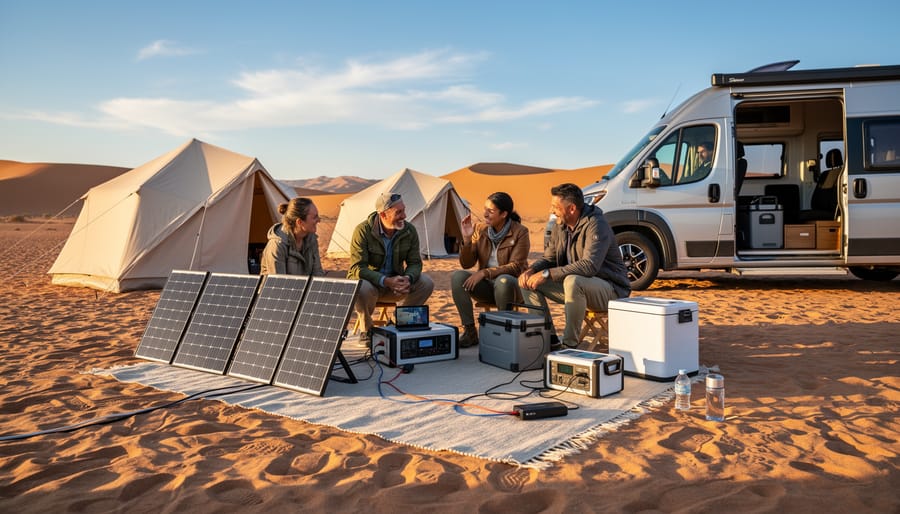
Power demands shape where you can park and how long you can stay. Solar panels give you the most freedom, 200-400 watts handles basics like charging devices and running lights, while 600+ watts supports larger draws like fans or a laptop all day. Pair solar with lithium batteries for better capacity and faster charging. Alternator charging refills batteries while driving, and shore power at campgrounds tops everything off. Track your daily watt-hours to size your system right, and consider whether you need to install an ERV or ventilation system if you’re running climate control.
For connectivity, most nomads juggle cell hotspots and public WiFi. Carriers vary by region, so having two different providers as backup helps when one has weak signal. WeBoost or similar signal boosters improve reception in remote areas, and co-working spaces or libraries provide reliable internet when you need bandwidth for video calls.
Creating Routines That Work Anywhere
The paradox of nomadic travel is that freedom requires structure. Without the anchors of a fixed home, your regular gym, your favorite coffee shop, your predictable commute, you need portable routines that ground you even as everything else shifts.
Start with non-negotiables. Maybe it’s coffee and journaling before anything else, a midday walk regardless of location, or a standing video call with friends every Sunday. These rituals become your internal compass when external surroundings constantly change.
For work, establish boundaries that don’t depend on place. One successful nomad I met works only until 2pm, then explores, whether parked at a beach or a Walmart lot. Another creates “office hours” by setting up the same workspace configuration daily, signaling to her brain it’s focus time.
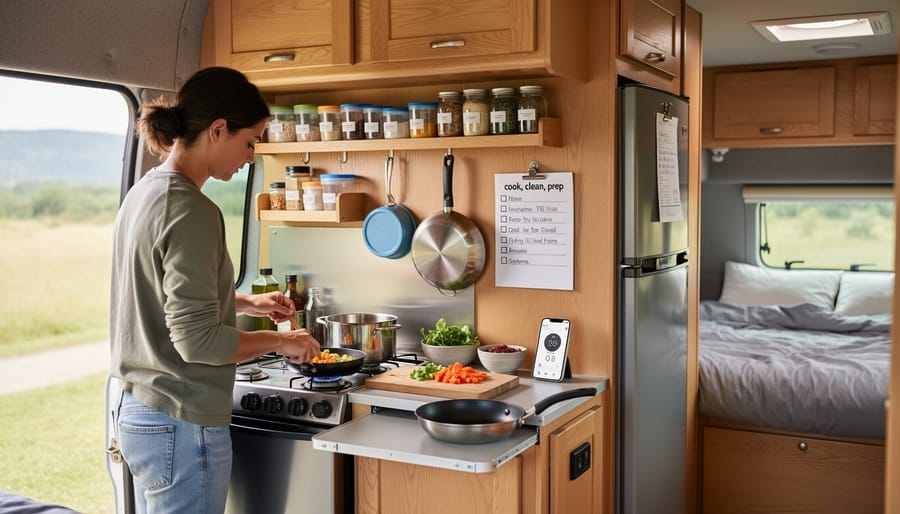
Cooking presents its own challenge in tight quarters. Master five simple meals you can make anywhere with minimal equipment and ingredients available at any grocery store. Prep ingredients during rest days so cooking doesn’t derail productivity when parked in transit.
Exercise works best when it requires zero equipment or planning. Bodyweight routines, yoga, hiking wherever you land, movements that happen because they’re effortless to start, not because conditions are perfect.
The real trick is flexibility within structure. Your routine should feel like a companion, not a constraint.
Navigating Challenges Every Nomad Faces
Staying Connected and Combating Loneliness
Loneliness hits differently on the road. You can be parked in the most beautiful spot on earth and still feel isolated. I remember my third week solo in Utah, gorgeous red rocks all around, zero human contact for five days. That’s when I realized community doesn’t just happen; you have to intentionally build it.
The easiest way to meet other nomads is through apps like iOverlander and Campendium, where you can see who’s nearby and sometimes coordinate meetups. Facebook groups for van life and nomadic travel often organize regional gatherings. Show up to these. Even introverts need occasional face time.
For staying close to stationary friends and family, schedule regular video calls, put them on your calendar like appointments. Send photos and voice messages instead of just texts; it keeps relationships richer. One trick that works: share your location temporarily when you’re somewhere cool so loved ones can follow along in real time.
Social media can connect you to the broader nomad community, but use it as a bridge to real conversations, not a replacement. Comment genuinely on others’ posts, then take those connections offline when paths cross.
The nomad community is surprisingly welcoming. Most people living this way understand the loneliness challenge and actively combat it together.
Handling Breakdowns and Unexpected Expenses
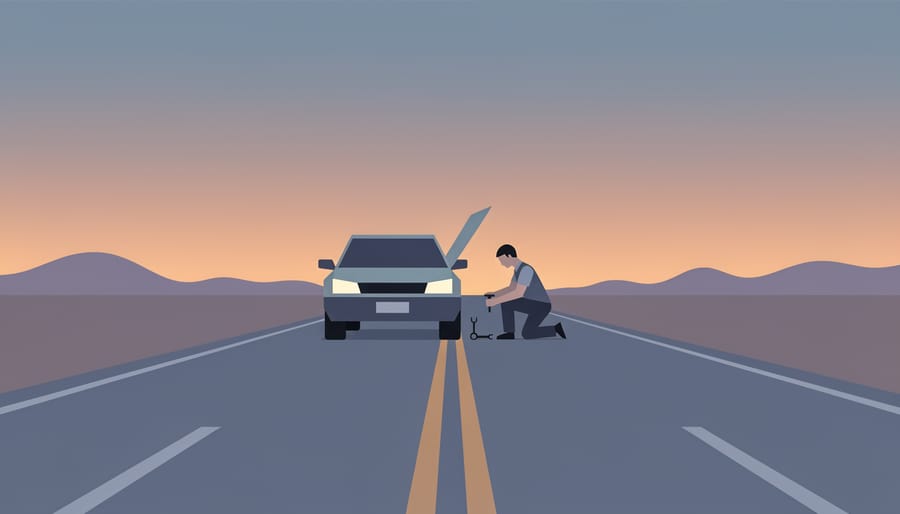
Three hours outside Boise in 2024, my alternator died on a Sunday. No cell service, 95-degree heat, and the nearest town had one mechanic who wouldn’t be back until Tuesday. I learned more about resourcefulness in those 48 hours than in my first year on the road.
Breakdowns aren’t if, they’re when. Start by building an emergency fund that covers at least two major repairs, think $3,000 minimum. Keep copies of your vehicle specs, service history, and a solid RV maintenance list in both digital and paper form. When something fails, you’ll want that information fast.
Finding trustworthy mechanics requires detective work. Ask other nomads in the area, check local Facebook groups, and read Google reviews carefully, look for detailed responses from the shop owner. Mobile mechanics exist in most regions and often charge less than brick-and-mortar shops. AAA or Good Sam memberships pay for themselves with a single tow.
Learn basic DIY skills before you need them: changing a tire, checking fluids, replacing fuses, troubleshooting electrical issues. YouTube tutorials are gold, but practice these tasks at home first, not during an actual emergency.
When disaster strikes, remember that the nomadic community shows up. That Sunday in Idaho, a passing van lifer lent me tools and helped diagnose the problem. The delay became an unexpected rest week in a beautiful spot. Most breakdowns make better stories than crises once you’re through them.
Dealing with Weather and Seasonal Considerations
Weather will test you more than you expect. I spent my first winter in a van parked in Montana because I stubbornly insisted I could handle anything. I couldn’t. By February I fled south, humbled and half-frozen.
Smart nomads follow the sun. Track seasonal patterns: spring and fall offer mild temps across most of the US, while summer sends you to elevation or northern latitudes. Winter means desert or southern coastlines. Download weather apps that show 10-day forecasts and radar, and check conditions at your destination before committing to a drive.
Prepare for extremes anyway. Insulate vulnerable pipes, carry a backup heating source, and know your vehicle’s temperature limits. Stock extra water when heading into heat. If a storm’s rolling in or temps are hitting dangerous levels, find a hotel or established campground, pushing through isn’t worth the risk or misery.
Making Nomadic Travel Sustainable Long-Term
The first year of nomadic travel runs on adrenaline and novelty. Everything feels like an adventure, even the inconveniences. But somewhere around month eighteen, maybe sooner, maybe later, the honeymoon phase fades and you’re left with the actual relationship. This is where sustainable nomadic travel begins: when you stop proving anything to yourself or anyone else, and start building a lifestyle that actually works.
Burnout hits nomads differently than it does office workers. You won’t necessarily feel it as exhaustion from doing too much. Sometimes it shows up as numbness toward beautiful places, irritability over minor logistics, or a creeping sense that you’re just moving without purpose. I’ve watched friends push through this phase thinking they could outrun it by changing locations faster, only to realize the problem wasn’t where they were, it was how they were traveling.
The key to longevity is permission to evolve. The version of nomadic travel that worked when you started won’t necessarily serve you five years in. Your vehicle needs might change. Your income strategy might need an upgrade. You might discover you prefer slower travel with month-long stays over constant movement, or vice versa. None of this means you’re failing at nomadic life, it means you’re getting better at it.
Watch for signals that your current approach needs adjustment:
- Feeling chronically exhausted despite adequate sleep and rest days
- Experiencing persistent financial stress or watching savings dwindle without a plan
- Vehicle maintenance issues piling up faster than you can address them
- Loss of joy in travel, places blur together or feel like obligations
- Major life changes like health issues, relationship shifts, or new responsibilities
When these signs appear, resist the temptation to white-knuckle through or abandon ship entirely. Instead, experiment with modifications. Spend a season in one place to rebuild your financial cushion. Upgrade a frustrating aspect of your setup. Take a month off the road in a short-term rental to reset. Join a caravan or convoy for built-in community. Switch from boondocking to campgrounds for a while, or the reverse.
Sustainability also means building in actual breaks. Not just rest days between drives, but intentional pauses where you’re not “doing” nomadic life, you’re just living. Park somewhere comfortable for two weeks and commit to not researching your next move. Let yourself be bored. Cook elaborate meals. Read fiction instead of travel blogs. This breathing room prevents the strange exhaustion that comes from treating every day like you’re supposed to be somewhere better.
The nomads who last aren’t the ones who never struggle. They’re the ones who treat their lifestyle as a living thing that needs tending, adjustment, and occasional radical change to stay healthy.
Common Questions About Nomadic Travel
The questions below come up in nearly every conversation I have with people curious about nomadic travel. You’re not alone in wondering about these practicalities, they’re the same concerns that kept me up at night before my first extended trip. Let’s tackle them head-on.
How do I handle mail and maintain a legal address?
Most nomads establish domicile in a tax-friendly state like South Dakota, Texas, or Florida, then use a mail forwarding service that scans and forwards mail as needed. Popular services include Escapees, Traveling Mailbox, and St. Brendan’s Isle, which provide both a legal address and mail management.
What about health insurance when I’m constantly moving?
Options include telehealth-friendly marketplace plans (check which states your plan covers), Christian health sharing ministries, travel insurance with medical coverage for international nomads, or maintaining coverage through an employer if you work remotely. Many nomads combine a high-deductible plan with a health savings account for flexibility.
Is nomadic travel safe for solo travelers, especially women?
Thousands of women travel solo successfully by trusting their instincts, researching areas beforehand, staying in well-populated or established camping areas when uncertain, and connecting with other nomads through apps like iOverlander or communities like Nomadic Women. The nomad community looks out for each other.
Can I travel nomadically with pets?
Absolutely, many nomads travel with dogs, cats, and even chickens. You’ll need to consider temperature management in your vehicle, regular vet care (apps like Airvet help find vets anywhere), pet-friendly camping policies, and ensuring your pet is comfortable with vehicle motion and changing environments.
What about traveling with kids and homeschooling requirements?
Nomadic families are increasingly common, and homeschooling laws vary by your domicile state (another reason many choose states with minimal homeschool regulations). Road-schooling turns travel into education through hands-on experiences, online curricula, and connecting with other traveling families.
How long should I try nomadic travel before committing fully?
Start with a one to three month trial if possible, keeping your safety nets intact. This gives you enough time to experience the realities beyond the honeymoon phase without burning bridges. Many people ease in gradually, weekends, then longer trips, then seasonal travel, before going full-time.
Where do I register my vehicle and get a driver’s license?
You’ll register your vehicle and maintain your driver’s license in your domicile state. The same states popular for mail forwarding (South Dakota, Texas, Florida) also offer straightforward vehicle registration processes for nomads, often without requiring physical vehicle inspections.
Beyond these common concerns, you’ll discover questions unique to your situation as you go. I thought I had everything figured out before my first trip, but reality taught me that the best answers come from experience, not endless research.
The nomadic community is remarkably generous with advice. When I couldn’t figure out propane regulations crossing state lines, three different nomads messaged me detailed explanations within an hour of posting in a Facebook group. When your solar setup isn’t working right or you need a dentist recommendation in an unfamiliar town, someone has been there and solved it.
Don’t let unanswered questions paralyze you. The logistics that seem insurmountable from your couch become manageable once you’re actually on the road. You’ll develop systems, find your rhythm, and realize that nomads before you have solved every problem you’ll encounter. Start moving, ask questions as they arise, and trust that you’ll figure it out, because you will.
There’s no single “right way” to be a nomad. What works for someone living full-time in a converted Sprinter van looks completely different from someone who camps weekends in a sedan, and both are legitimate expressions of nomadic travel. Your version of this lifestyle should reflect your circumstances, your comfort level, and what you’re seeking from the experience.
Start smaller than you think you need to. Take a weekend trip before committing to a month. Try car camping before buying a van. Work remotely from a campground for a week while you still have your apartment. Every nomad I know wishes they’d worried less about having everything perfect before leaving and spent more time actually on the road learning what they truly needed.
You’ll make mistakes. Your first parking spot will probably be lousy. You’ll pack things you never use and forget things you need daily. Your budget estimates will be off. That’s not failure, that’s how you figure out your personal system. The nomadic community thrives on sharing these lessons, and you’ll find an unexpected generosity among people living this way.
The transformative part isn’t the exotic locations or the freedom from rent, though those matter. It’s discovering what happens when you strip away the default settings of stationary life and actively choose how you want to spend your days. That shift in perspective stays with you.
Welcome to the community. We’ll see you out there.